
Wildlife Removal Services
Bat Removal and Exclusion in Northern Virginia
No trapping, no poison, no sealing in summer — the only method that works is a properly timed exclusion.
Licensed in VA (#56104) and MD (#049372). Family-owned, 20+ years, answering 24 hours a day.
How to Tell You Have a Bat Roost
A colony in the attic is quieter than people expect. What you usually notice first is the smell — an ammonia sharpness from accumulated guano — or a soft chittering and rustling in a wall or ceiling around dusk as the colony wakes and leaves.
Then look outside at sunset. Stand back from the house and watch the gable end and the roofline for fifteen minutes after the light goes; if there is a roost, you will see them dropping out of one specific gap. Other reliable signs: dark greasy staining around a gap where fur oils have rubbed the surface, small piles of guano on siding or below a soffit, and guano in the attic that crumbles to a glittering powder — that shine is undigested insect wing, and it is how bat droppings are told apart from mouse droppings.
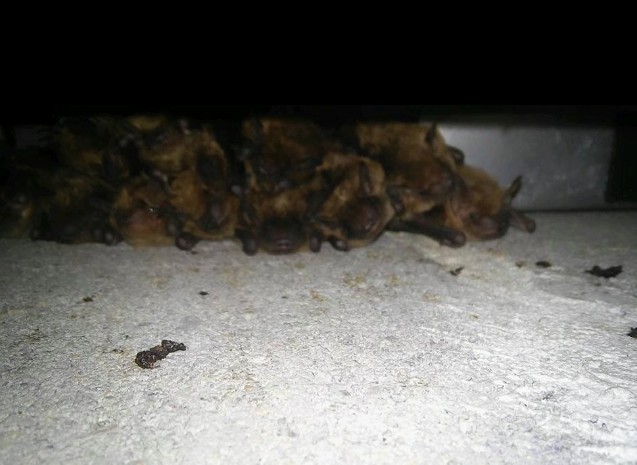
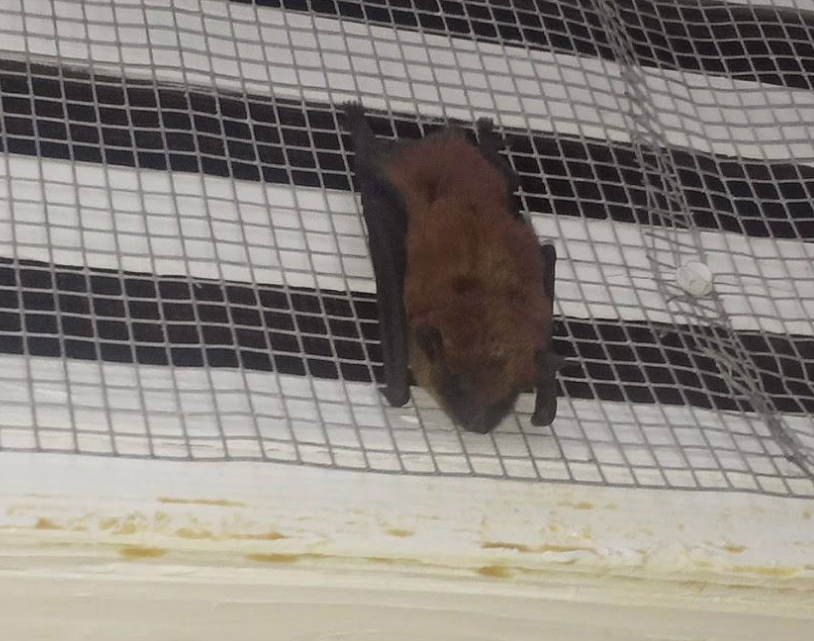
The species roosting in Northern Virginia attics are usually the Big Brown Bat and the Little Brown Bat.
Why Exclusion Is the Only Method
A roost is removed by exclusion: one-way devices fitted over the active entry points that let a bat leave and not get back in, while every other gap larger than about a quarter inch is sealed first. After several nights the colony has emptied itself out, the devices come off, and the last openings are closed.
A quarter inch is the number that matters. A Little Brown Bat gets through a gap the width of a pencil, which is why a bat exclusion is far more detailed work than a squirrel job: ridge vents, gable louvers, flashing seams, the gap behind a fascia board, mortar joints, and the small triangular openings under corrugated roof edges all have to be closed.
Maternity Season: Why We Sometimes Say Not Yet
From roughly May through August, flightless pups are in the roost. During those months a one-way device would let the adults out and seal the pups in. They die in the wall, and you get weeks of odor and an insect problem — and in Virginia it is the wrong thing to do to a protected animal.
So in maternity season we do the preparation work: full inspection, sealing every gap that is not an active entry, and where a bat is getting into living space, safe capture and removal. The exclusion itself is completed once the pups are flying. Any company willing to seal your roost in June is either inexperienced or not telling you what happens next.
And if a bat has been in a room with a sleeping person, a child, or anyone unable to say reliably whether contact occurred, the bat should be safely captured rather than released — the Virginia Department of Health may want it tested. Call your health department in that situation, and call us the same day.
How the Job Runs
1. Inspection and watch
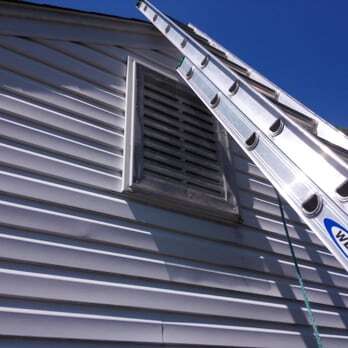
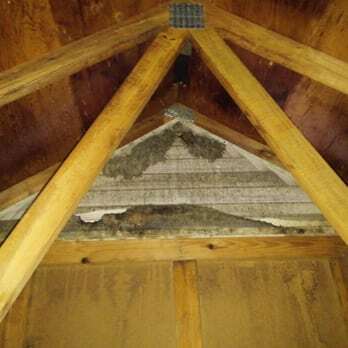
We survey the roofline, ridge, gables and flashing for staining and gaps, inspect the attic for guano and roost sites, and where needed watch the emergence at dusk to confirm the active exits.
2. One-way exclusion
Every non-active gap sealed first, then one-way devices over the active entries so the colony leaves and cannot return. Timed around maternity season.
3. Permanent seal
Devices removed and the last openings closed to a quarter-inch standard in metal, mesh and sealant appropriate to the surface.
Why Homeowners Call BEDR
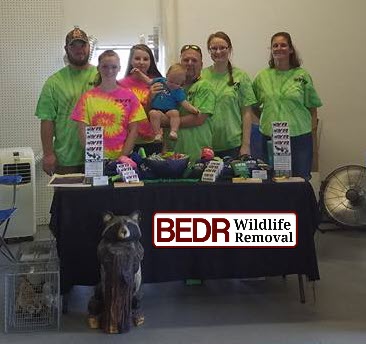
- 20+ years, family-owned — you deal with the people doing the work.
- Licensed in Virginia (#56104) and Maryland (#049372).
- Humane and legal methods — we work inside Virginia’s relocation and protected-species rules, not around them.
- We seal, not just trap — the reason customers do not call us back about the same animal.
- 24/7 answering, with same-day service across Northern Virginia.
- Full restoration in-house — attic cleanup, insulation, chimney caps, crawl space work.
Humane Solutions. Lasting Results.
Frequently Asked Questions
There is a bat flying around inside my house right now. What do I do?
Shut the interior doors, open one window or exterior door, turn the lights down and let it find the opening. Do not swat at it. If it was in a room with someone sleeping, a young child, or a pet, do not release it — contain it safely and contact your local health department about testing. Call us and we will come out.
It is July and I want them gone now. Why the wait?
Because flightless pups are in the roost until the end of summer, and excluding now seals them in to die in your wall. We seal everything that is not an active entry immediately and complete the exclusion once they are flying.
Can you not just trap or spray them?
No. One-way Exclusion is the only method that actually works.
Is bat guano actually dangerous?
It can be. Accumulated guano can support Histoplasma capsulatum, a fungus whose spores cause a respiratory infection when disturbed and inhaled. That is why we remove it in protective equipment rather than sweeping it out.
How long does a bat exclusion take?
The sealing work is typically one to three days depending on the house. The one-way devices then stay up for several nights before the final seal. In maternity season the completion is scheduled for after the pups fly.
Get Your Bat Roost Excluded the Legal Way
Inspection first, exclusion timed correctly, then the house sealed to a quarter inch. We answer 24 hours a day.
Other Wildlife Removal Services
Squirrel Removal · Raccoon Removal · Bird Nest Removal · Snake Removal · Groundhog Removal · Skunk Removal · Fox Removal · Opossum Removal · Mole Removal
Where We Work
Fairfax · Alexandria · Arlington · McLean · Vienna · Reston · Herndon · Falls Church · Woodbridge · Fredericksburg · Chantilly · Centreville · King George