
Wildlife Removal Services
Squirrel Removal in Northern Virginia
Scratching and rolling sounds overhead at first light, and again just before dark. That pattern is a squirrel, not the house settling — and the longer it runs, the more of your attic it costs you.
Licensed in VA (#56104) and MD (#049372). Family-owned, 20+ years, answering 24 hours a day.
How You Know It Is Squirrels and Not Something Else
Squirrels are the animal we remove most often in Northern Virginia, and they are also the easiest to identify by ear. They are diurnal: you hear them for an hour or two after sunrise and again as the light goes, and the attic is silent at 2 a.m. Raccoons are the opposite, and mice never stop. The sound itself is light, fast and rolling — scampering along a joist, or an acorn being rolled across the ceiling drywall.
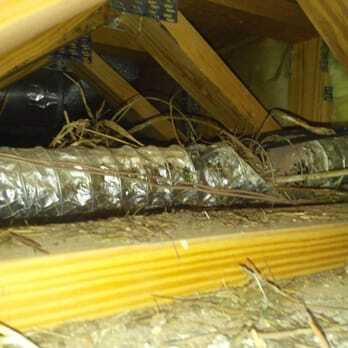
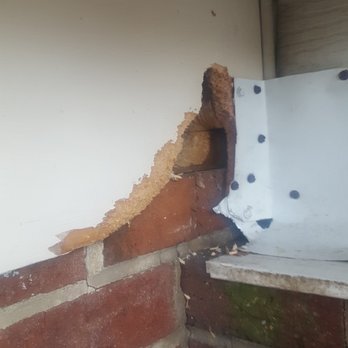
The rest of the evidence is visual: a clean-edged hole roughly two inches across at a corner, gable vent or soffit return · chewed fascia and drip edge · shredded insulation pushed into one corner · small dark droppings near the entry · and staining where the fur oils have rubbed the wood smooth around the hole.
Where They Get In, and Why It Is Usually the Same Five Spots
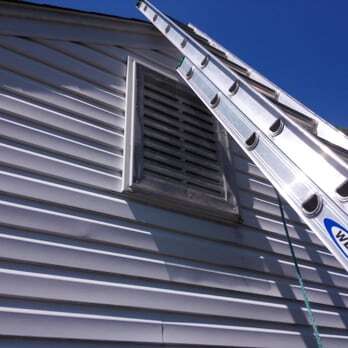
An adult gray squirrel needs a gap of about an inch and a half. On most Virginia houses that gap already exists somewhere along five places: the soffit return where the roof meets the wall, the gable vent, the roof-line drip edge, the siding-to-brick transition, and any construction gap where a dormer or addition meets the original structure.
Where the gap is slightly too small, they make it bigger. Squirrel incisors grow continuously and have to be worn down, so chewing is not incidental damage — it is what the animal does all day. Inside the attic that same behaviour lands on wiring, and a chewed conductor buried in blown insulation is a genuine and well-documented fire risk. It is the single strongest reason not to wait out a squirrel.
Why Timing Matters: Squirrels Breed Twice a Year
Gray squirrels have two litters a year in Virginia — roughly February to April and again August to September — with three to five young per litter. A single female that moves into your soffit in February is five animals by late March.
This changes how the job has to be done. If a nest of pups is in the attic and the entry point is simply sealed, the mother is locked out and the litter dies inside your ceiling. You get an odor problem for several weeks, then a fly problem, and the drywall usually has to come out. We check for young before anything is closed, and hand-remove a litter when one is there.
Relocation is also not an option in Virginia. Under Va.
How the Job Runs
1. Inspection
We walk the roofline, soffit returns, gable vents and the siding transitions, then go into the attic to find the entry points, the nest and the chewing. You get photos of what we find.
2. Removal
Trapping at the entry point, one-way doors where they suit the structure, and hand-removal of any litter. We confirm the attic is empty before anything gets closed.
3. Exclusion in metal
Every opening sealed in heavy-gauge metal flashing, steel mesh or hardware cloth. Never foam or caulk — a squirrel chews through either one in an afternoon.
Why Homeowners Call BEDR
- 20+ years, family-owned — you deal with the people doing the work.
- Licensed in Virginia (#56104) and Maryland (#049372).
- Humane and legal methods — we work inside Virginia’s relocation and protected-species rules, not around them.
- We seal, not just trap — the reason customers do not call us back about the same animal.
- 24/7 answering, with same-day service across Northern Virginia.
- Full restoration in-house — attic cleanup, insulation, chimney caps, crawl space work.
Humane Solutions. Lasting Results.
Frequently Asked Questions
How long does squirrel removal take?
Most jobs run three to ten days end to end. The inspection and the initial work happen on day one; the wait is for the last animal to clear the structure before we seal. Restoration can be the same visit or a scheduled return.
I only hear them in the morning. Is that really a squirrel?
Almost certainly. Squirrels are active at dawn and dusk and quiet overnight. If the noise is loudest after dark and sounds heavy — thumping rather than scampering — you are more likely dealing with a raccoon.
Can I just seal the hole myself?
Please do not, not until the attic is confirmed empty. Sealing an occupied attic traps the animals inside, and in spring or late summer that usually means a litter dying in your ceiling. Squirrels also chew straight back through foam, wood filler and caulk.
Will they come back?
Not through a sealed opening. Squirrels return to the same structure because the opening is still there and the scent trail leads to it — which is why trapping alone fails and exclusion does not.
Do you repair the damage as well?
Yes. Attic cleanup, insulation replacement, soffit and fascia repair, chimney caps and vent guards are all in-house. On most squirrel jobs the repair is the larger half of the work.
Get the Squirrels Out and the Attic Sealed
Every week you wait is more chewed wiring, more soiled insulation and a bigger repair. We answer 24 hours a day.
Other Wildlife Removal Services
Raccoon Removal · Bat Removal · Bird Nest Removal · Snake Removal · Groundhog Removal · Skunk Removal · Fox Removal · Opossum Removal · Mole Removal
Where We Work
Fairfax · Alexandria · Arlington · McLean · Vienna · Reston · Herndon · Falls Church · Woodbridge · Fredericksburg · Chantilly · Centreville · King George